



Cost control 101:
Download your free construction budgeting template
Download the free construction budgeting template created by the team at Breakthrough Academy to improve your financial processes.

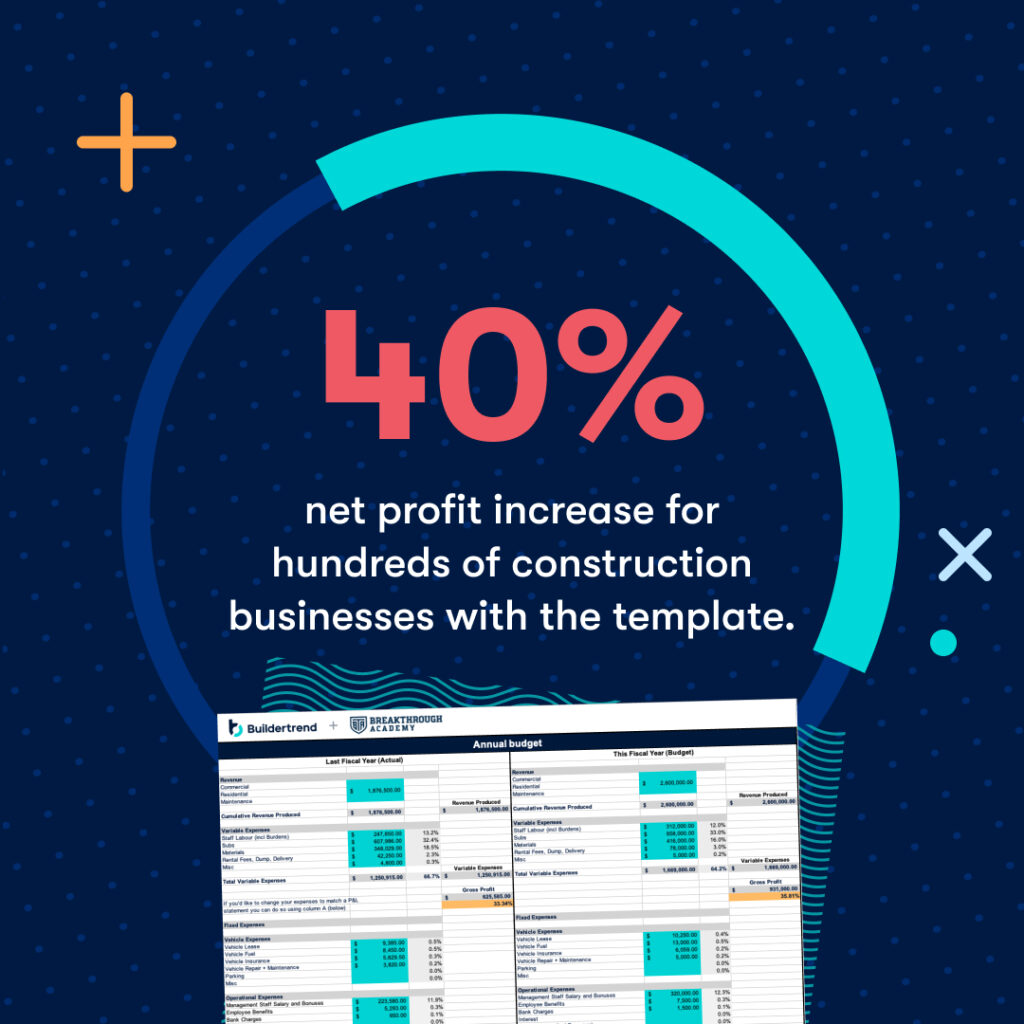
Breakthrough Academy’s construction budgeting template
This budget template allows builders to see where they can be more profitable – as well as where they’re losing money. Hundreds of construction business owners are already seeing an average of 40% net profit increase when using this construction budget template.
This template was designed for:
General contractors
Home builders
Remodelers
Specialty contractors
Benefits of using this template:
- Finally go from uninspiring margins to healthy profits
- Get a clear idea of what you should be tracking and where to focus attention
- Plan a year in advance so you can hire more staff or buy new equipment when you need to
How to start using this template in five steps:
Input last year’s financials
Review last year’s data
Set your net profit goal for this fiscal year
Build this fiscal year’s budget
Review and plan for change
What is a construction budgeting template?
A construction budgeting template is a tool that helps builders, remodelers, contractors and other professionals in the construction industry manage their finances effectively. It’s a predesigned spreadsheet or document that allows construction pros to track and allocate funds for various aspects of a construction project.
A construction budget template serves as a roadmap for managing expenses throughout the project’s lifecycle. It typically includes categories such as labor costs, materials costs, permits and fees, equipment rentals, subcontractor fees and contingencies.
These templates are designed to be user-friendly and customizable, so they’re easily modified to suit specific project requirements.
Why you should use a construction budgeting template
By using a construction budgeting template, professionals in the construction industry can streamline their financial planning processes and make informed decisions regarding resource allocation. This tool not only helps them stay within budget but also provides transparency and accountability throughout the entire project duration.
A budget template specifically tailored to the needs of the construction business allows a builder to gain a comprehensive overview of their financial resources and expenditures.
Build and customize your own project budgets in Buildertrend
Once you use Breakthrough Academy’s budget template to determine your profits for the year, you can use Buildertrend to dive into the details and control your costs for every job.
The Buildertrend Budget tool is a valuable resource for builders, remodelers and specialty contractors. It’s a feature within Buildertrend’s project management software that specifically focuses on construction budgeting.
This tool allows construction businesses to effectively manage their budgets and track expenses throughout the entire project lifecycle. By using the Buildertrend Budget, construction pros can easily create detailed budgets for each project, allocate funds to different categories or line items and monitor spending in realtime.
The Buildertrend Budget feature offers a user-friendly interface that simplifies the budgeting process, making it accessible even to those without extensive financial expertise. It provides a centralized platform where all financial data related to a project can be stored and accessed by relevant team members.
With this tool, builders can accurately estimate costs, set realistic budgets based on project requirements and client expectations and make informed decisions regarding resource allocation. The Budget ultimately helps streamline financial management within the construction industry while enhancing transparency and accountability.
Create a budget plan for your business
Construction budgeting template FAQs
Get answers to the most common construction budgeting template questions.
When it comes to construction budgeting, having a detailed budget template can greatly benefit builders, remodelers and contractors. The level of detail in your budgeting template will depend on the specific needs and requirements of your construction business.
A comprehensive construction budgeting template should include all the necessary categories and subcategories to accurately capture the various costs involved in a project. This may include items such as labor costs, material costs, permits and fees, equipment rentals, subcontractor expenses, overhead costs and contingency funds.
By having a detailed budgeting template in place, you can effectively track expenses and ensure that you stay within your allocated budget. This not only helps with financial planning but also allows for better decision-making throughout the project lifecycle.
Ultimately, the level of detail in your construction budgeting template should align with your specific business needs. It’s important to strike a balance of providing enough granularity to accurately capture costs while also maintaining simplicity for ease of use. Regularly reviewing and updating your budget template as needed will ensure that it remains relevant and effective for managing your construction projects successfully.
When using a construction budgeting template, it’s important to be aware of common pitfalls that can hinder its effectiveness. Understanding these pitfalls can help builders, remodelers, contractors and other construction professionals make the most out of their budgeting process and ensure accurate financial planning.
- Failing to customize the template to suit specific project requirements
- Not accounting for unexpected costs or contingencies
- Inaccurate data entry
- Not using advanced technology to improve accuracy
- Overlooking ongoing monitoring and review of the budget
By being mindful of these common pitfalls when using a construction budgeting template, you can optimize your budgeting process, avoid costly mistakes and achieve more accurate financial planning for your construction projects.
The key components of a construction budgeting template typically include:
- Project details: This section includes information such as project name, location, start and end dates and client details.
- Cost categories: A comprehensive list of cost categories is essential for accurately estimating expenses. Common categories may include labor costs, materials, permits and fees, equipment rentals, subcontractor fees, insurance costs and contingency funds.
- Cost estimates: Builders can input estimated costs for each cost category based on their experience or by using construction software that provides accurate pricing data.
- Actual costs: As the project progresses, actual costs incurred can be recorded in this section to track any deviations from the initial estimates.
- Variance analysis: This component allows builders to compare estimated costs against actual costs to identify any discrepancies or areas where adjustments need to be made.
- Payment schedule: A payment schedule outlines when payments are due from clients or when subcontractors need to be paid. It helps ensure timely cash flow management throughout the project.
- Profitability analysis: Builders can analyze their profit margins by comparing total expenses against projected revenues or contract amounts in this section.
- Notes and comments: This component allows users to add additional information or specific details related to certain cost items or any other relevant notes for reference.